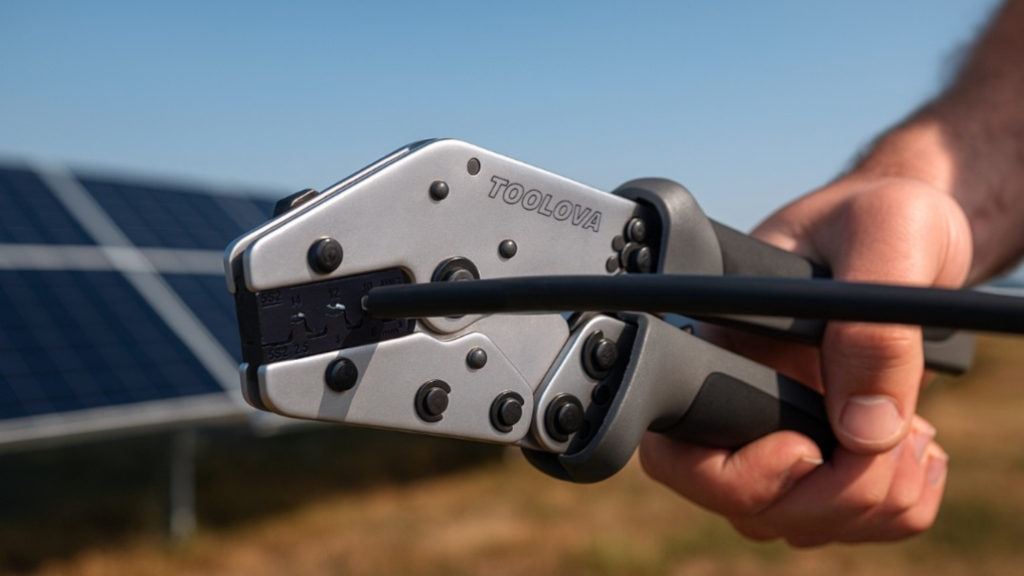
Why tool quality dictates system safety – and how to reliably identify high-quality crimping pliers for PV installations.
Why Tool Quality Dictates System Safety
The operational reliability and efficiency of a photovoltaic system often depend on an overlooked detail: the quality of its electrical connections. A reliable energy yield starts with the tool installers use to process the solar cables.
Stripping: The First Step in the Crimping Process
Before crimping, the solar cables must be stripped—either manually or automatically. Manual wire strippers feature blades precisely matched to the conductor cross-section, delivering consistently clean results; the drawback is that a suitable tool is required for each specific cross-section. Automatic wire strippers self-adjust to different cross-sections and speed up installation, though highly reliable models are currently still limited in availability. To be on the safe side, choose certified brand quality and test the tool's function and handling before purchasing.
Crimping Tools: Wide Selection, Vast Differences in Quality
For the actual crimping process, the range of available tools is significantly broader, but differences in quality are not always immediately obvious. The critical component is the crimp die—the specific profile that permanently and securely compresses the connector. Weak points in budget crimping pliers often lie in ergonomics, handling, and durability; an inferior tool betrays itself through a loose, rattling construction, weak springs, and a noticeably light weight. Such deficiencies compromise cost-effectiveness and potentially system safety, whereas robust, solidly manufactured tools deliver reliable results.
The Rattle Test, Ratchet Inspection, and Examining the Die
Two simple checks help in assessing tool quality. In the "rattle test," quality is demonstrated by minimal play between the components: a high-quality tool does not rattle and feels noticeably heavier in the hand due to its solid construction. During the ratchet inspection, the ratcheting mechanism should not sound like cheap plastic—such a sound indicates thin sheet metal and insufficient material quality. Ergonomic handles without visible molding flash also show that the manufacturer takes user comfort seriously.
A central quality indicator is the crimp die itself: its pressing surface should not only be cleanly manufactured but polished. Polished dies deform the connector material evenly and smoothly, preventing material residue from sticking or the metal from being unevenly compressed. The result is smooth, uniformly shiny, and cleanly rounded crimps—a reliable sign that the tool and the application match.
Common Crimping Mistakes and Their Consequences
Substandard tooling frequently leads to faulty crimps. The direct consequence is increased electrical resistance in the connection; under load, the contact point heats up, which in extreme cases can lead to a fire. Especially with the DC connectors of a PV system, the quality of the crimping process is therefore crucial to operational safety. A clean crimp is the foundation of a permanently resilient connection.
Quality Consciousness That Pays Off
How consequential installation errors can be is documented by the "Solar Bankability" project by Trust-PV: according to their findings, faulty installation and cabling represent the most frequent cause of failure in photovoltaic systems. For installers and system operators alike, a consistent focus on quality directly pays off—high-quality tools are less a matter of comfort than a prerequisite for permanently reliable connections.
Source Note & Further Information
First Publication: August 27, 2025
Source: https://www.photovoltaik.eu/wartung/emc-direct-crimpen-nur-mit-hochwertigem-werkzeug
Arnd Diedrichs is the Head of Product Management at EMC-direct.